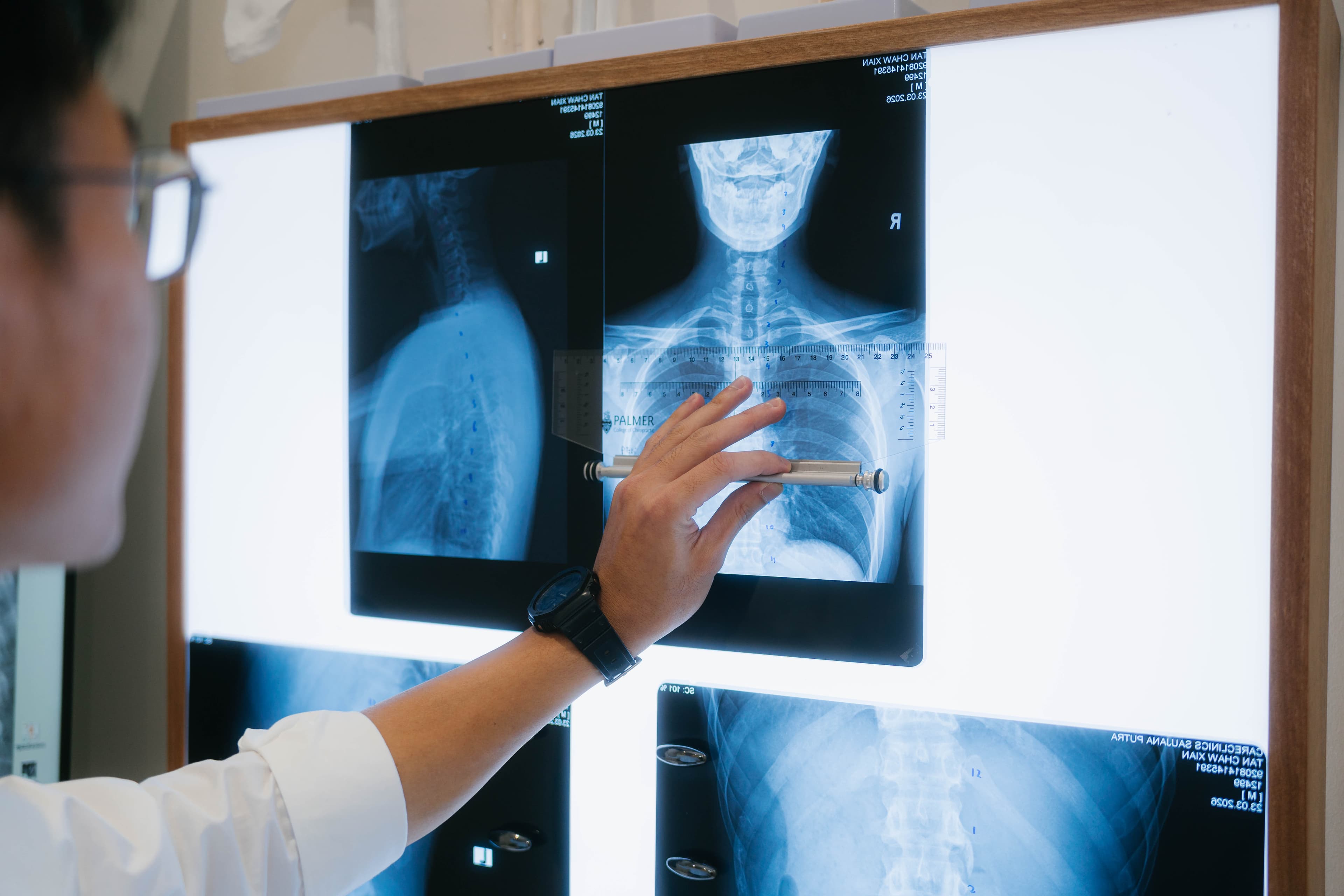
Do You Need an X-Ray to See a Chiropractor? What Gonstead Chiropractors Look For
Not every chiropractic visit requires an X-ray. But when your chiropractor recommends one, it's usually because they want to see your spine's structure directly rather than guess at it. In Gonstead chiropractic, X-ray analysis is one of the core diagnostic tools we use to find the exact level and direction of a spinal misalignment before we ever adjust you.
Why would a chiropractor ask you to get an X-ray?
Your chiropractor recommends an X-ray when they need to see the bone structure of your spine, not just feel it. Physical examination tells us a lot about how you move and where you're tender. It doesn't tell us the exact angle a vertebra has rotated, or whether there's a structural issue that changes how we should treat you.
X-rays are also used to rule things out. If you've had trauma, a fall, or unexplained symptoms that don't fit a simple mechanical pattern, imaging helps confirm there isn't a fracture, deformity, or underlying condition that needs a different kind of care first. That's a safety check, not just a diagnostic one.
At TGC, an X-ray is more likely to be recommended if your case involves:
- Trauma or a recent fall. We need to rule out fractures before applying any manual adjustment.
- Postural conditions. Scoliosis, kyphosis, or a visible change in spinal alignment over time.
- Chronic or unresponsive pain. Symptoms that haven't followed the pattern we'd expect from a straightforward muscular or joint issue.
- A history of spinal surgery or significant prior injury. We need to see the current structure before deciding how to proceed.
- Suspected degenerative changes. Arthritis or disc space narrowing that would change how firmly or specifically we adjust.
If none of these apply to you, there's a good chance your first visit won't need imaging at all. Palpation and motion testing are often enough on their own.
What does an X-ray actually show your chiropractor?
An X-ray shows your chiropractor the bones of your spine and how they're positioned relative to each other. It reveals things a hands-on exam can't, including the exact angle of a vertebra, disc space narrowing, old fractures, arthritic changes, or postural conditions like scoliosis and kyphosis.
Chiropractors take spinal X-rays for a range of reasons, including diagnosing pathology or trauma, guiding treatment decisions, ruling out contraindications to care, and analysing spinal biomechanics. Not every reason carries equal evidence behind it, which is why the specific clinical justification matters more than the imaging itself.
X-rays can only show you bone. They don't show muscle strain, disc bulges, or nerve irritation directly. If we suspect a soft tissue issue instead of a structural one, X-ray usually isn't the right tool, and we'll say so.
How does Gonstead chiropractic use X-ray analysis specifically?
Gonstead chiropractic is built around finding the single most involved spinal level and correcting it precisely, and X-ray analysis is one of five ways we confirm that level before we adjust. The others are static palpation, motion palpation, instrumentation such as the nervoscope, and visualisation of your posture.
Where Gonstead differs most from general chiropractic is in how the X-ray is used. We're not just looking for obvious pathology. We take a full spine film, usually a 14 by 36 inch image covering the entire spine and pelvis, made up of a small number of exposures stitched together into one continuous view, and perform a line drawing analysis on it. This means measuring the exact angle and direction each vertebra has shifted from where it should sit.
That measurement tells us precisely which segment to adjust, and in which direction. It's the difference between knowing a general area is "tight" and knowing that one specific vertebra has rotated a measurable number of degrees to one side. The adjustment we deliver is built around that number.
This isn't just a Gonstead tradition, it's been studied directly. Research into the Gonstead pelvic marking system found good inter and intra-examiner reliability, meaning different practitioners measuring the same film tend to land on similar findings. A separate review of spinal displacement analysis methods came to a similar conclusion when the techniques are performed properly and consistently.
This is why Gonstead chiropractors are often described as more specific than other techniques. We're not adjusting broadly and hoping it helps. We're correcting the one segment the evidence points to, based on what we feel in your spine, what we observe in your posture, and what we measure on the film together. All three need to agree before we adjust.
Is X-ray radiation from a chiropractic scan safe?
A full spine X-ray series exposes you to a small, medically justified dose of radiation, and current guidelines are clear that it should never be used routinely or repeated without a specific clinical reason. This follows the ALARA principle, short for "as low as reasonably achievable," which is the standard guiding radiation use in healthcare generally. One imaging session is usually enough to give your chiropractor the structural information needed for months or years of care.
A 2018 narrative review by Jenkins et al., published in Chiropractic & Manual Therapies, found that current evidence supports spinal X-ray use mainly in diagnosing trauma and spondyloarthropathy, and in assessing progressive structural deformities such as adolescent idiopathic scoliosis. The same review was clear that spinal X-rays should not be used as routine, repeated imaging outside those situations.
That distinction matters. One imaging session used to confirm a diagnosis and guide precise treatment is very different from repeated imaging used without clear justification. If you're ever asked to get scanned on a recurring schedule without a specific clinical reason, that's worth questioning.
To put the dose in context, radiation exposure from spinal X-rays ranges from about 0.2 mSv for a cervical (neck) X-ray up to 2.7 mSv for a three-region spine series, according to the same 2018 review. That's a low dose for one imaging session overall, generally comparable to less than a year of natural background radiation. It's not zero, which is exactly why it needs to be justified. But it's also not the significant exposure some patients worry about when they hear the word "X-ray".
We also weigh the cost of not imaging. If a structural issue goes unseen and we adjust without knowing it's there, the risk to you may be higher than the small dose of one imaging session. Every recommendation we make is a comparison between those two risks, not a default habit.
What happens at TGC if you need an X-ray?
At Thrive Gonstead Chiropractic, we don't take X-rays in-house. In Malaysia, chiropractors aren't permitted to operate imaging equipment or write radiology reports ourselves, so if imaging is clinically justified, we refer you to a radiology provider near Bandar Rimbayu for the scan and report.
This is actually a change from how we used to practise. Both Ruth and I trained and worked in Australia, where we held radiography licenses in Queensland and Victoria. There, we took our own spinal X-rays and wrote our own reports as part of clinical practice. In Malaysia, that step is handled by a licensed radiology provider instead, and we do the Gonstead-specific line drawing analysis on the films once we receive them.
If you already have recent X-rays from a hospital, clinic, or another practitioner, bring them to your consult. In many cases we can use existing imaging instead of ordering a new scan, which means less radiation exposure and a faster path to your analysis.
Once we receive your films, the analysis itself happens in-house. We don't outsource the line drawing or the clinical interpretation. Ruth and I read the film against your exam findings ourselves, because that comparison is what determines your correction, not the radiology report on its own. The radiologist's report tells us whether anything unexpected shows up. Our own analysis tells us where and how to adjust.
What to expect after your X-ray
After your X-ray is taken, we review it against your physical exam findings, not on its own. The film confirms or adjusts what we found through palpation and motion testing, and together they point to the exact segment we'll focus on.
You'll get a clear explanation of what the X-ray shows, in plain language, before any adjustment is made. If a finding changes how we approach your care, such as ruling out a certain type of adjustment, we'll explain why and what we'll do instead.
We'll also show you the film itself and point out what we're looking at. You don't need a background in radiology to understand it. If your spine has rotated at a specific level, we'll show you where, and explain how that connects to the symptoms you came in with. Understanding your own spine tends to make the rest of your care make more sense too.
For most patients, one imaging session is enough to guide the entire course of care. We don't re-X-ray simply because time has passed. If your presentation changes significantly, or if we need to confirm progress on a structural correction such as a postural condition, we'll discuss that with you directly rather than schedule it as routine.
Frequently asked questions
Do I need an X-ray for my first chiropractic visit? Not always. An X-ray is recommended when your history, symptoms, or exam findings suggest a structural issue, trauma, or postural condition that needs to be seen directly rather than felt.
Will I need repeat X-rays during treatment? Usually not. One imaging session generally provides enough structural information to guide care for an extended period. Repeat imaging is only used when there's a specific clinical reason to reassess.
Can I bring X-rays from another clinic or hospital? Yes. If your existing imaging is recent and covers the relevant area, we can often use it directly for analysis instead of ordering a new scan.
Does Gonstead chiropractic always require an X-ray? No, but when it's clinically indicated and available, X-ray is usually part of the best recommendation. When there are limitations to getting imaging, the rest of the assessment, palpation, motion testing, and visualisation, can still build enough of a clinical picture to proceed safely.
Is chiropractic X-ray radiation dangerous? One full spine imaging session involves a small, medically justified dose, made up of a few exposures rather than one shot. Guidelines are clear it shouldn't be used routinely or without a specific clinical need, which is the standard we follow.
Ready to find out what's going on in your spine?
An X-ray isn't about finding something wrong. It's about knowing exactly what we're working with before we touch your spine. If you've been dealing with pain that hasn't made sense on its own, we'd like to take a proper look. Book a consult with us at Thrive Gonstead Chiropractic in Bandar Rimbayu, and let's find out what your spine is actually telling us.
References
- Jenkins HJ, Downie AS, Moore CS, French SD. Current evidence for spinal X-ray use in the chiropractic profession: a narrative review. Chiropractic & Manual Therapies. 2018;26:48. https://doi.org/10.1186/s12998-018-0217-8 (open access: https://pmc.ncbi.nlm.nih.gov/articles/PMC6247638/)
- Plaugher G, Hendricks AH. The inter- and intraexaminer reliability of the Gonstead pelvic marking system. Journal of Manipulative and Physiological Therapeutics. 1991;14(9):503-8.
- Harrison DE, Harrison DD, Troyanovich SJ. Reliability of spinal displacement analysis of plain X-rays: a review of commonly accepted facts and fallacies with implications for chiropractic education and technique. Journal of Manipulative and Physiological Therapeutics. 1998;21(4):252-66.
- Centers for Disease Control and Prevention. Guidelines for ALARA – As Low As Reasonably Achievable. Radiation and Your Health. https://www.cdc.gov/radiation-health/safety/alara.html