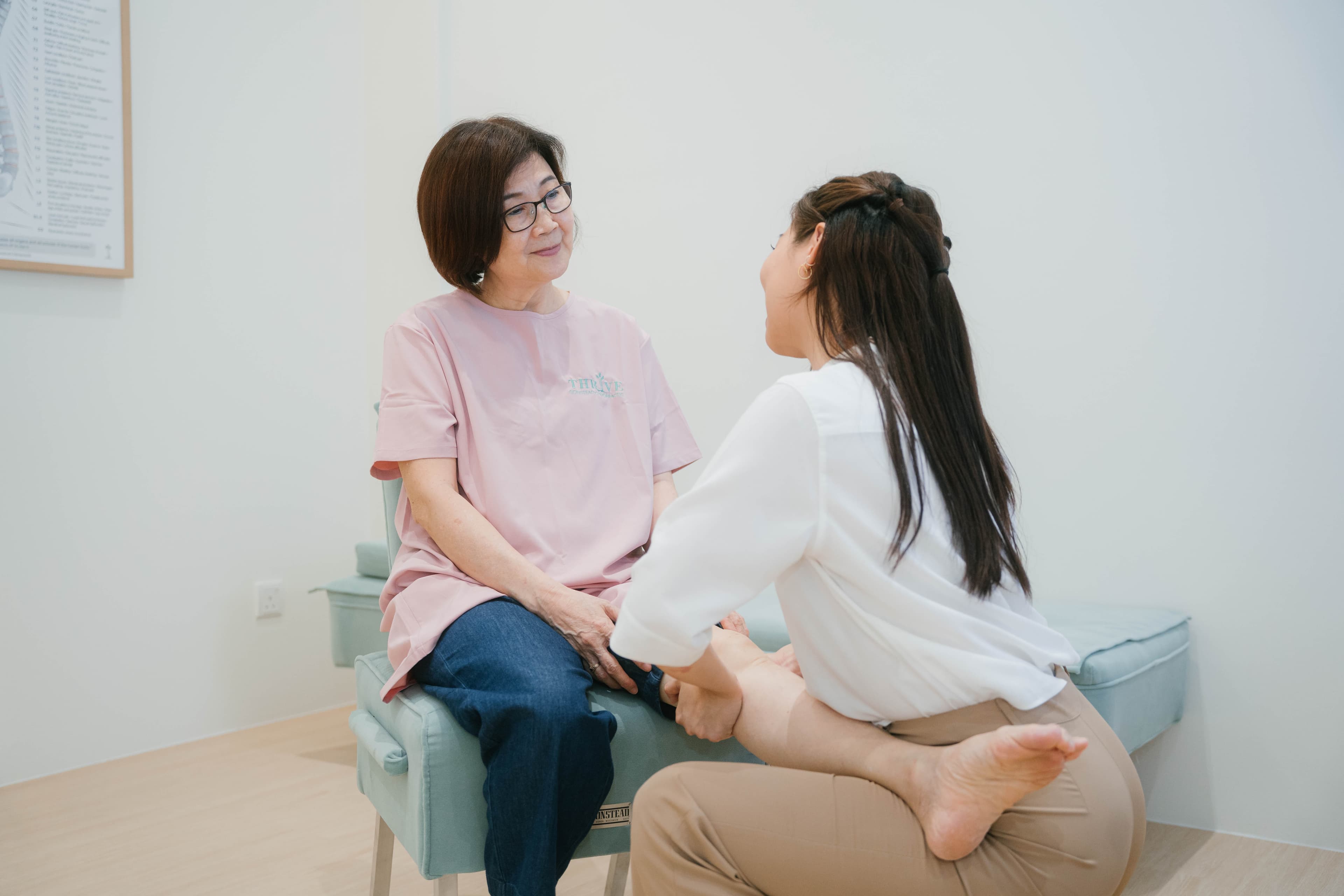
Knee pain usually comes from one of a few places: the joint itself, the tendons and ligaments around it, or the nerves and mechanics further up the chain in your hip and spine. Most cases respond well to a proper assessment that looks at how you move, not just where it hurts. At Thrive Gonstead Chiropractic in Bandar Rimbayu, we check your spine and pelvis alongside your knee because the two are often connected.
Why does your knee hurt?
Your knee hurts because something in the joint or around it is under more load than it can handle. That might be the cartilage, a ligament, a tendon, or the way your kneecap tracks when you bend and straighten your leg. Pain is your body's signal that a structure is irritated or under strain.
You might notice it going up and down stairs, after a long run, or when you stand up from sitting. Some people feel it as a sharp catch, others as a dull ache that builds through the day. Either way, the location and pattern of the pain usually point to what's going on.
Swelling, stiffness in the morning, or a knee that gives way are all worth paying attention to. These details help narrow down whether the issue sits inside the joint, in the soft tissue around it, or somewhere else entirely.
What's actually causing your knee pain?
Most knee pain falls into a handful of common categories, each with a different mechanism. Getting the right one matters because the treatment approach changes depending on what's actually driving the problem.
- Patellofemoral pain – the kneecap tracks unevenly in its groove, usually from muscle imbalance or hip weakness, causing pain at the front of the knee.
- Meniscus irritation – the cartilage cushioning the joint gets strained or torn, often from twisting under load.
- Ligament strain – the ACL, MCL, or other stabilising ligaments are overstretched, common in sports with sudden direction changes.
- Iliotibial band tightness – the band of tissue running down the outside of your thigh pulls on the knee, common in runners.
- Osteoarthritis – the cartilage wears down over years, leading to stiffness and pain that's worse after rest.
Each of these has a mechanical cause. Your job, and ours, is to find out which one applies to you rather than treating knee pain as one generic problem.
Can your knee pain actually be coming from your back or hip?
Yes. Your knee sits between your hip and your ankle, so any change in how your pelvis or lumbar spine moves changes the load going through your knee. A nerve irritated at the L3 or L4 level in your lower back can also refer pain down the front of your thigh into your knee.
If your pelvis sits unevenly, one leg effectively works harder than the other with every step you take. Over months, that uneven load shows up as wear, inflammation, or tracking problems in the knee, even though the knee itself started out completely healthy.
This is why we never assess a knee in isolation. We check your lumbar spine, your pelvis, and your hip alignment as part of the same picture. In practice, patients with chronic knee pain who haven't improved with knee-only treatment often show a clear finding higher up the chain.
Fixing the knee without checking the spine is treating the symptom and missing where the problem started.
How does Gonstead chiropractic address knee pain?
Gonstead chiropractic addresses knee pain by finding the single most involved area of spinal or pelvic misalignment that's changing how you walk, stand, and load your knee. We don't adjust broadly. We find the specific segment causing the problem.
Your assessment includes static and motion palpation to feel how your spine and pelvis move, and instrumentation such as the nervoscope to detect areas of nerve irritation along your spine. X-ray analysis, where indicated, gives us a structural view of your alignment that guides exactly where and how we adjust.
Subluxations can also occur at the knee itself, not just in your spine or pelvis. Where we find one, we adjust the knee directly using the same principle of specificity, correcting the exact joint restriction rather than working around it. The pelvis and lumbar spine are still checked every time because they're so often part of the picture, but the knee gets treated as its own joint when it needs it.
The goal is to correct the specific misalignment driving the uneven load, not just to manage the ache in your knee.
What can you expect from treatment?
Most patients with mechanical knee pain linked to pelvic or spinal misalignment notice a change in how the knee feels within the first few adjustments. That doesn't mean the knee is fully resolved. It means the load through it starts to normalise.
Where there's structural damage, like a torn meniscus or ligament, chiropractic care won't repair the tissue itself. What it can do is remove the mechanical strain that's slowing your recovery or making the pain worse than it needs to be.
Timelines vary depending on how long the problem has been building and whether there's any structural damage involved. A knee that's been compensating for a pelvic imbalance for years takes longer to settle than one that's been off for a few weeks.
Frequently asked questions
Does chiropractic help with knee pain even if the knee itself feels fine to touch? Yes. Knee pain often comes from altered mechanics higher up in your hip or spine, so the knee can hurt even when nothing is structurally wrong with the joint itself.
Is knee pain from the back different from knee pain from the knee? Referred knee pain from the lower back often feels like a dull ache or a nerve-type sensation down the thigh, while joint-based knee pain is usually more localised and worsens with specific movements.
Do I need an X-ray before starting treatment? Not always. We use X-ray analysis when it helps confirm the exact structural finding, but a thorough physical assessment is often enough to identify a clear mechanical cause.
Can Gonstead chiropractic help runner's knee? Yes. Runner's knee is frequently linked to hip and pelvic control, so correcting alignment through the pelvis often reduces the load causing the irritation at the kneecap.
How many sessions does it usually take to notice a difference? Many patients notice a change in how the knee feels within three to five visits, though full correction of the underlying misalignment takes longer depending on how established the pattern is.
Can the knee itself be adjusted, or is treatment only through the spine? Both. Subluxations can occur at the knee joint itself, and where that's found, it's adjusted directly using the same specific approach applied to the spine and pelvis.
Your knee pain has a specific, findable cause, and more often than not, part of that cause sits in your spine or pelvis rather than the knee alone. If you've been treating the knee without lasting results, we'd like to take a proper look at what's actually driving it at Thrive Gonstead Chiropractic in Bandar Rimbayu.