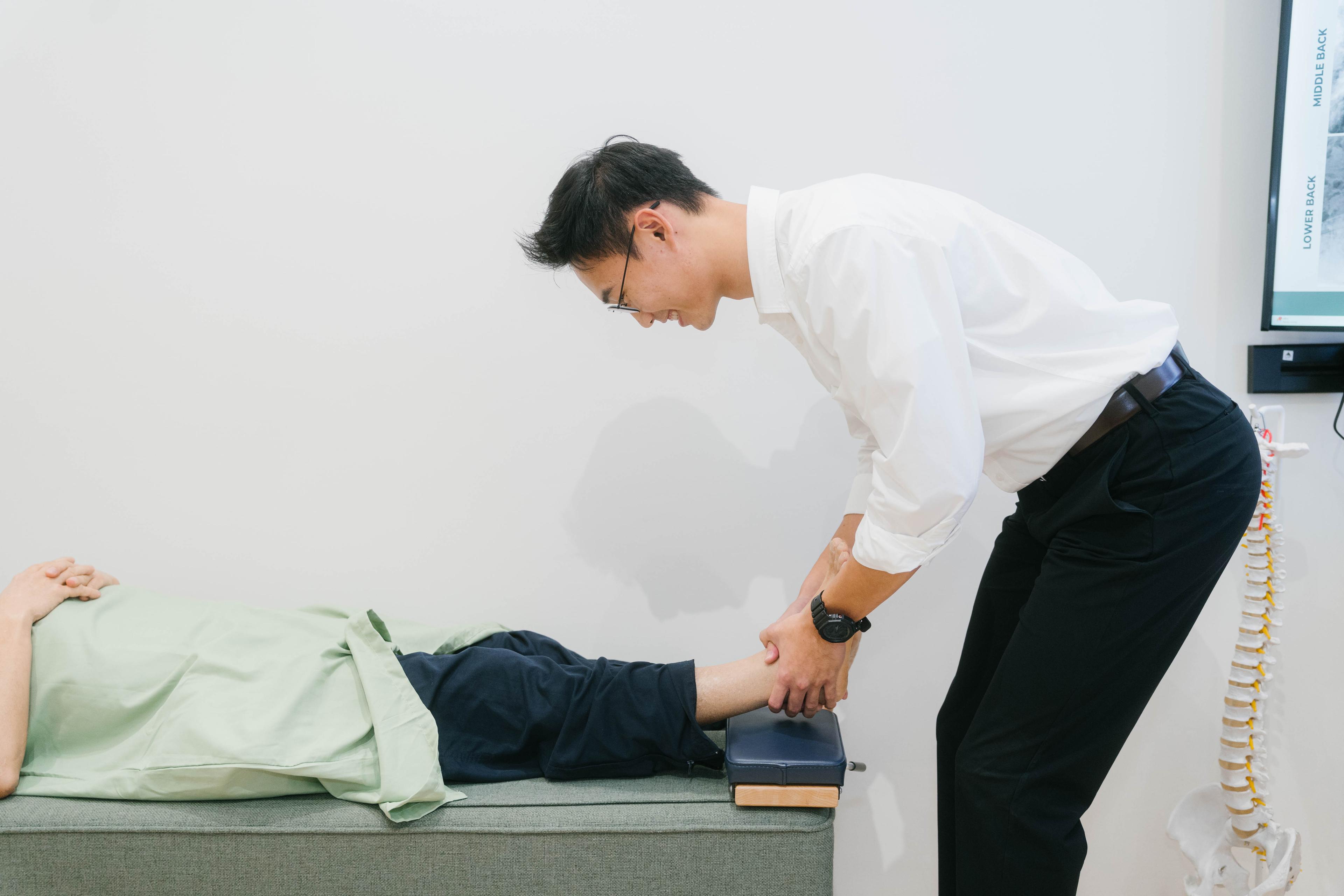
Sports chiropractic is the care of the spine, pelvis and joints for people who train, play and compete. At Thrive Gonstead Chiropractic in Bandar Rimbayu, we look at how your spine and limbs move together when you run, kick, lift or swing. We look for the places where that movement has stopped working well. Correcting those patterns can ease pain and may help lower the chance of the same injury coming back.
Why do sports injuries keep coming back?
Most sports injuries do not start with one bad move. They start with a small imbalance that the body quietly works around for weeks or months, until one session pushes it past its limit. Many people rest the sore knee or tight calf, feel better, and go straight back to training. The pain fades, but the reason it started is still there.
If that pattern sounds familiar, you have probably been treating the symptom and not the cause. Rest and stretching help the tissue recover, but they do not change how your joints stack and move under load. That is why the same hamstring, shin or shoulder flares up every few months.
What does your spine have to do with a sore knee or ankle?
Your legs and trunk share one moving system. Your pelvis sits between your spine and your hips, and your hips control how your knees and ankles absorb force when you land, push off or change direction. If the lower back or pelvis does not move evenly, the forces that should spread through the whole leg concentrate in one or two joints.
Think of a runner whose left hip does not rotate as freely as the right. Over many kilometres, the left knee may take a little more twist with every stride. The knee is not the weak point in that story. It is simply where the extra load finally shows up.
This is why we check the spine and pelvis even when the injury is in the arm or the leg. A shoulder that catches during a smash may be taking on load from a neck that moves unevenly. Looking only at the sore spot tends to miss the source.
How does Gonstead chiropractic assess an athlete?
Gonstead chiropractic starts by finding the one spinal segment that is most involved, rather than adjusting the whole spine the same way every visit. For an athlete, that precision matters. A small restriction in one joint can change how the rest of the body moves under load, and it can do so in ways that are hard to see from the outside.
Your assessment at TGC begins with a conversation about your training, your history and the moment the injury started. Then we look at how you stand, sit, bend and walk. We use static palpation to feel how your joints sit when you are still, and motion palpation to feel how each segment moves through its range.
We also check for temperature differences along the spine, and we use the nervoscope to look for areas of altered nerve function. Each finding is compared against the others, so your treatment plan follows what your body shows us rather than a routine. Where weight-bearing X-rays will help your assessment, we arrange them at a nearby imaging facility and review them with you.
What does a sports chiropractic visit involve?
Each visit depends on where you are in your recovery, but most sports patients move through a similar sequence. The steps below show the usual order. Your plan will change as your body responds.
- Review your training load, any recent changes, and when the pain started.
- Assess how your spine, pelvis and affected limb move and load.
- Adjust the most involved spinal segment or joint where the findings support it.
- Release tight muscles and restore movement in joints that have lost range.
- Set a short rehab plan, such as strengthening or movement drills, to carry into the gym or field.
- Re-check the same movements at the next visit to measure change.
Step five matters most for athletes. An adjustment changes how a joint moves, but strength and control keep that change in place once you return to training. In practice, patients who skip this step often notice the old pattern returning within a few weeks.
Which sports injuries can chiropractic help with?
Chiropractic care suits injuries that involve the spine, the pelvis, and the joints that load through them. We see these most often in runners, footballers, badminton players, cyclists and gym-goers. The common areas we assess include:
- Lower back and pelvis strain from lifting, cycling or rowing
- Knee pain, including patellofemoral pain and IT band irritation
- Ankle sprains that keep recurring or feel unstable
- Hip and groin pain from running or sudden changes of direction
- Shoulder and neck pain from throwing, smashing or heavy overhead work
- Shin pain and calf tightness from running load
- Headaches and neck stiffness after long training sessions or long desk days
If an injury involves a fracture, a suspected ligament tear, or a serious loss of strength, you need imaging and a medical assessment first. We refer those cases to a physiotherapist, podiatrist or orthopaedic specialist, and we can work alongside them. Knowing when to refer is part of good care.
What should you expect in the first few weeks?
In practice, many athletes notice some change within the first few visits, especially when the pain came from a recent flare-up. An older or more complex injury takes longer to settle. How long depends on how long the pattern has been there and how consistently you do your rehab.
We review your progress regularly. If the joint is not moving better or the pain is not easing, we change the plan or refer you on. We would rather tell you that early than keep you in a routine that is not working.
How strong is the research on chiropractic for athletes?
The best evidence comes from one randomised trial in semi-elite Australian Rules footballers, published by Hoskins and Pollard in 2010. Players who received sports chiropractic alongside their usual medical and sports science care had significantly fewer lower-limb muscle strains, and they missed far fewer weeks to non-contact knee injuries. The trial was small, and the hamstring results did not reach statistical significance.
Research on performance gains is weaker. Reviews have found that the evidence does not yet show chiropractic improves athletic performance in healthy athletes. For knee and lower-limb problems more broadly, most published work is still case-based, so we treat chiropractic as one part of a rehab plan, not a guaranteed fix. That is why strengthening and movement work carry as much weight in your plan as the adjustments.
What do people usually ask before their first sports visit?
Can I keep training while I am getting chiropractic care?
It depends on the injury and on which movements hurt. After your assessment, we tell you which movements to reduce, which to keep, and which to stop for now. Pain that sharpens during a movement is a signal to back off that movement, not to push through it.
Do I need to stop playing my sport completely?
Usually not. A sudden sharp pain, new numbness, or swelling that is getting worse means you should rest and get assessed quickly. Otherwise, we adjust the load so the injured area can recover while the rest of your training continues.
How do I know if I need a doctor or physiotherapist instead?
Injuries with fractures, significant swelling, loss of strength, or symptoms that do not improve need medical assessment first. We will refer you when that is the right call, and we can work with your doctor or physiotherapist on your recovery.
Is sports chiropractic only for professional athletes?
No. We treat people at every level, from those who run a few times a week to those who compete in weekend leagues or for professional teams. If an exercise hurts your body, your level of play does not change whether a check is useful.
Your body is built to move under load without flaring up every few months. If a sports injury keeps returning, come and see us at TGC in Bandar Rimbayu. We will look at the whole chain, find the part that matters most, and build a plan you can train with. Does your injury keep coming back after you feel better?